



1. Hungary’s Proposed New Wealth Tax
In October 2026, the Hungarian Government published draft legislation proposing the introduction of an annual wealth tax for individuals holding net assets exceeding HUF 1 billion (approx. EUR 2.74 million). Under the draft, the tax would be levied at a rate of 1% on the taxable wealth exceeding this threshold, with a higher rate of 1.5% applying to the portion of taxable wealth exceeding HUF 100 billion (approx. EUR 274 million).
The proposed tax regime would apply to both Hungarian tax residents and non-residents. Hungarian tax residents would generally be subject to tax on their worldwide assets, whereas non-residents would be liable only in respect of specified Hungarian assets. The proposed tax base is broad and includes real estate, bank deposits, securities, investments in companies, crypto-assets, precious metals, artworks, collections, jewellery and other taxable assets. Genuine and adequately documented liabilities may be deducted from the tax base.
For non-residents, the proposed tax would generally cover Hungarian real estate and related property rights, as well as shareholdings in Hungarian companies and foreign companies holding Hungarian real estate.
According to the draft legislation, the new rules are intended to enter into force on 15 December 2026. The first tax assessment would be based on the assets held as of 31 December 2026, with the first tax return and payment due by 31 August 2027. The draft also provides for specific anti-avoidance measures, potentially affecting transactions undertaken on or after 14 May 2026 that are considered to circumvent the proposed tax rules.
Further, as a separate measure, Hungary's Government is considering the possibility of introducing an exit tax for wealthy individuals relocating abroad and/or transferring their assets outside Hungary. However, the precise scope, conditions and implementation timeline of this proposal remains uncertain.
In view of the planned introduction of the wealth tax in Hungary, potentially affected individuals may wish to explore relocation to Switzerland and the possibility of benefiting from its lump-sum taxation regime. This newsletter provides an overview of the Swiss lump-sum taxation regime for Hungarian citizens considering relocation to Switzerland.
2. Benefits of Swiss Lump-Sum Taxation
In addition to Switzerland’s high standard of living, political and economic stability, and excellent healthcare system, the lump-sum tax regime offers tax advantages for eligible Hungarian citizens, including:
- Low tax burden: The annual minimum tax liability may be approx. CHF 150'000 – CHF 170'000, depending on the canton and personal circumstances
- Tax predictability: The expected tax burden can be estimated before relocation based on the confirmed tax ruling
- Simplified reporting: Generally, no declaration of worldwide income and assets is required for lump-sum tax assessment
- Expenditure-based taxation: Taxable income is based on annual living costs rather than worldwide income and wealth, subject to minimum thresholds and the control calculation.
3. How Can Hungarian Citizens Relocate to Switzerland Under the Lump-Sum Tax Regime?
As Hungary is a member of the European Union, Hungarian citizens benefit from the Agreement on the Free Movement of Persons (AFMP) between Switzerland and the EU. Hungarian citizens who intend to reside in Switzerland without gainful employment may obtain a residence permit if they demonstrate sufficient financial resources to support themselves and their family members, as well as health and accident insurance.
Residence rights and eligibility for lump-sum taxation are separate matters. Individuals considering this tax regime should seek an advance tax ruling from the cantonal tax authorities in their intended canton of residence. The tax ruling application should be submitted before relocation to clarify the applicable tax treatment and tax factors.
Not all Swiss cantons offer lump-sum taxation. The regime has been abolished in five cantons: Zurich (ZH), Basel-Stadt (BS), Basel-Landschaft (BL), Schaffhausen (SH) and Appenzell Ausserrhoden (AR). The remaining 21 cantons retain the regime.
4. Eligibility for the Lump-Sum Taxation
To qualify for lump-sum taxation in Switzerland, an individual must meet the following conditions:
- No Swiss citizenship
- The individual takes up residence in Switzerland for the first time or after an absence of at least ten years
- No gainful employment in Switzerland.
In case of married couples, both spouses must fulfill these requirements.
The restriction on gainful employment requires particular attention. For example, holding a board position in a foreign company or managing international investments may raise questions about whether the individual's activities constitute gainful employment in Switzerland. The assessment depends on the nature of the activities and where they are physically performed. Activities carried out abroad should therefore be reviewed individually with the competent cantonal tax authorities before relocation.
As the treatment of gainful activities carried out abroad may vary depending on the nature of the activity and the applicable cantonal practice, it is essential to discuss the proposed arrangements with the relevant cantonal tax authorities before relocating to Switzerland.
5. Calculation of the Lump-Sum Tax
Under the Swiss lump-sum taxation regime, the taxable income is generally determined by reference to the taxpayer’s total annual living expenses, both in Switzerland and abroad. However, the taxable income cannot be lower than the applicable minimum assessment thresholds.
At federal level, the minimum taxable income is CHF 434'700 (subject to confirmation for the relevant tax year). In addition, the taxable income must generally be at least seven times the annual rental expense or the rental value of the taxpayer’s principal residence in Switzerland. Cantonal and communal minimum assessment bases are determined separately and may vary significantly between cantons.
The following table shows minimum taxable income bases for selected cantons:
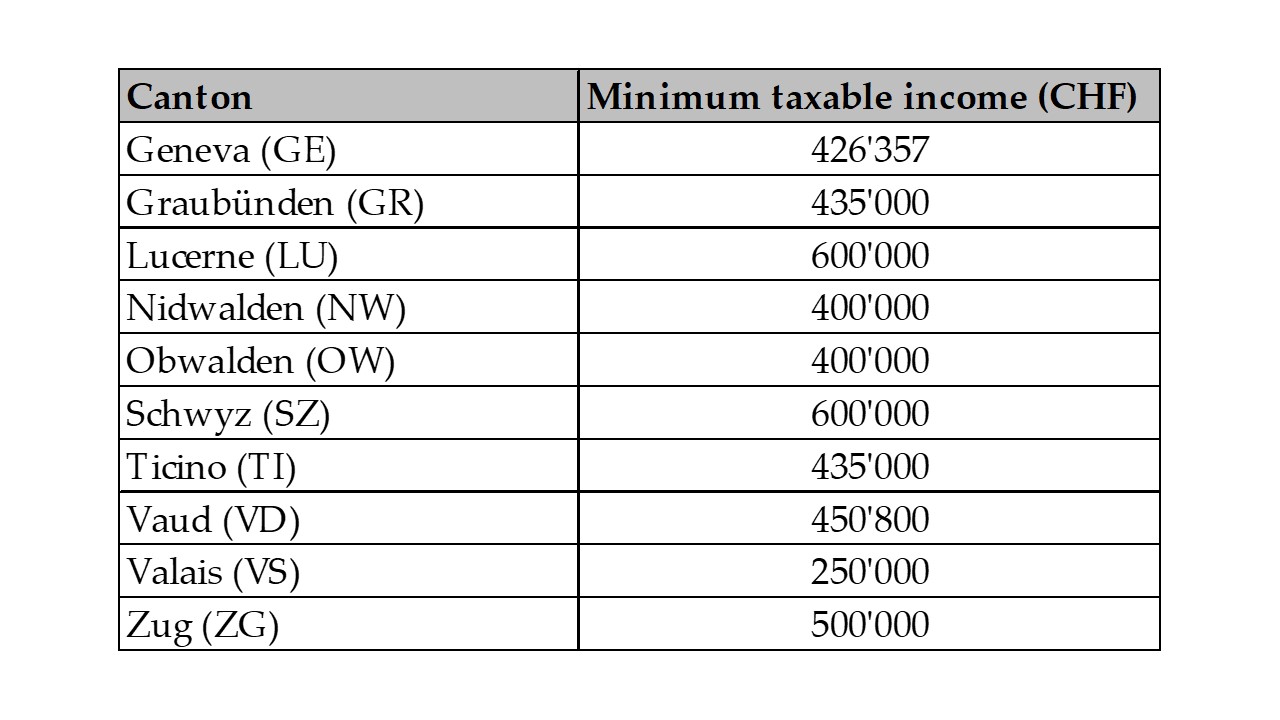
The above figures should be verified for each tax year.
In practice, the taxable income is generally determined by reference to the highest applicable amount among the following:
- The taxpayer’s worldwide annual living expenses
- Seven times the annual rental expense or rental value of the principal residence in Switzerland
- The applicable minimum income tax base under federal, cantonal and communal rules.
Wealth tax is levied at cantonal and communal level, as Switzerland does not impose a federal wealth tax. In most cantons, the minimum taxable wealth under the lump-sum tax regime is determined by reference to a multiple of the applicable income tax base.
The precise taxable income and wealth bases are defined individually in the tax ruling with the canton of residence.
Once the taxable base has been determined, the applicable federal, cantonal and communal tax rates are applied. As tax rates vary significantly between cantons, a higher minimum taxable income, as indicated in the table above, does not necessarily result in a higher overall tax burden.
For Hungarian citizens considering relocation to Switzerland, the total annual tax burden under the lump-sum regime may fall within the average minimum range of CHF 150'000 to CHF 170'000. This should be treated as an illustrative estimate rather than a guaranteed outcome, as the actual amount depends on the canton and municipality of residence, the agreed taxable bases, the taxpayer’s circumstances and the applicable tax rates.
Control calculation
The determined taxable base is subject to the control calculation as part of the annual tax return. Notably, there is no obligation to declare foreign-sourced income and foreign wealth, except in specific cases where the taxpayer wishes to claim relief under an applicable double tax treaty. In such cases, the relevant foreign income must be disclosed in order to invoke treaty benefits.
The purpose of the control calculation is to ensure that the tax payable under the lump-sum regime is not lower than the ordinary income tax that would be due on the following categories of income:
- Swiss-source income, including rental income from Swiss real estate, dividends and interest from Swiss securities, Swiss pensions, and royalties, and
- foreign-source income for which the taxpayer claims relief under a double tax treaty.
6. Additional Expenses
In addition to annual taxes, individuals relocating to Switzerland under the lump-sum tax regime should consider the following major expenses:
- Social security contributions of approx. CHF 26'500 per year
- Medical insurance of approx. CHF 6'000 per adult per year (costs vary based on coverage and insurer; this is only an indicative estimate).
7. Timeline
Before relocating to Switzerland, an individual should obtain a tax ruling from the tax authorities of their intended canton of residence confirming the application of the lump-sum taxation and applicable taxable bases for income and wealth. This allows them to obtain an estimate of their anticipated annual tax burden before moving.
In parallel, individuals should arrange accommodation in Switzerland, whether temporary or permanent, to establish their intended place of residence.
Once the cantonal tax authorities have issued the tax ruling, which may take approximately two to three weeks, the individual can submit the required documents, including the tax ruling, to the competent cantonal migration authority as part of the residence permit application.
Following approval of the residence permit application, which may take approximately two further weeks, the individual will generally be invited to provide biometric data for the issuance of the residence permit card.
The overall process may take approx. one to two months, depending on the canton.
8. Hungarian Tax Considerations Prior to Relocation
Although the proposed wealth tax legislation and exit tax rules have not yet entered into force and their final provisions remain uncertain, the potential for retroactive application or the review of certain prior transactions should be carefully considered. In particular, the draft anti-avoidance provisions of the proposed Wealth Tax Act contemplate the review of transactions carried out on or after 14 May 2026. Therefore, Hungarian citizens should carefully assess the potential Hungarian tax implications of any planned relocation to Switzerland, including the consequences of transactions undertaken before the move.
Our specialists will be happy to support you throughout the relocation process, from identifying a suitable Swiss canton and place of residence based on your individual needs, tax considerations and lifestyle preferences to addressing the associated Swiss tax, legal and immigration matters.